|
Once
at the School for Architecture and Decorative
Arts, however, Escher realized that his true
passion lay in the graphic arts. He spent the
next two years at art school, where he mastered
graphic and woodcutting techniques. Upon completion
of his schooling, he traveled extensively through
Southern France, Spain and Italy. During these
travels, he garnered numerous inspirations for
his work. Throughout his career as an artist,
Escher was fascinated by the art of structure.
Though his early work tended toward realistic
portrayals of the landscape and architecture
observed during his travels, it reflected a
greater fascination for structural constructs
than for the landscape itself. The inspiration
there lay the foundation for his work after
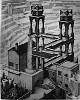
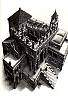
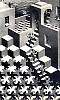
1937, for which he is most famous. These works
involve repeated patterns and regular divisions
of the plane, impossible constructions, and
infinite space. His work from then until his
death in 1972 was driven by a unique understanding
of mathematical concepts. Through his wondrous
creations, Escher was able to lay a symbolic
bridge between the realms of art and science.
|